Mechanical Lock Metal Roofing: Complete Buyer’s Guide
2026-09-16 20:13:54
If you're a roofing contractor or regional distributor sourcing panels for commercial and industrial projects in the U.S., this guide is written for you. Mechanical lock metal roofing is a standing seam system where vertical panel legs are physically crimped together using power seaming tools, forming either a single-lock (90°) or double-lock (180°) seam. That mechanical interlock — not friction, not exposed screws — is what separates this system from snap-lock and through-fastened profiles, and it's why specifiers on low-slope, high-wind, and heavy-snow projects treat it as the default choice.

What Is Mechanical Lock Metal Roofing?
The Core Mechanism
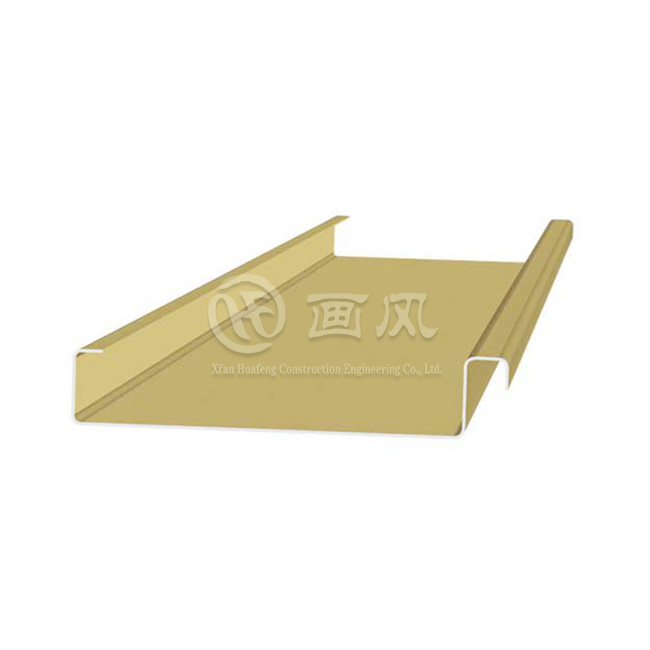
A automatically sewn standing seam panel has a male leg and a female leg that cross over at the rib. Next, they are folded together using a seaming tool that can be powered by electricity or a hand crank. The end result is a single, continuous seam that runs the length of the panel and has no visible screws that go through the weather surface. The panel is attached to the base by floating clips that are hidden inside the seam. These clips allow the panel to move easily during thermal cycling, which stops the fastener fatigue that happens with through-fastened systems over time.
Single-Lock vs. Double-Lock
When folded in half, single-lock seams make a 90° angle and can be used on slopes of 2:12 or more. The double-lock seams fold in half and a butyl sealant bead is applied at the factory inside the female leg. This makes the profile waterproof down to a pitch of 0.5:12, which is the minimum level needed for large warehouse roofs, distribution centers, and retrofits where drainage is slow. Both designs need to meet ASTM E1592 for wind uplift resistance and ASTM E1646 for water penetration resistance.
Benefits and Performance Characteristics
Why Contractors and Specifiers Trust This System
The case for mechanically seamed roofing's success is based on facts that can be measured, not on marketing speak. The Metal Construction Association (MCA) says that when placed on slopes above 0.5:12, standing seam metal roofs always do better than low-slope membrane systems in lifetime cost analyzes. In terms of structure and operation, this system has these main benefits:
- Wind uplift resistance rated at ≥ 90 mph (144 km/h) According to the International Building Code, wind uplift resistance must be at least 90 mph (144 km/h). However, tested assemblies achieved well above that level using ASTM E1592 protocols, which is very important for projects in hurricane- and coastal-prone areas where NOA compliance is required.
- Hydrostatic watertightness Hydrostatic watertightness is achieved through a smooth lock design rated IPX4 or higher. This eliminates the risk of capillary entry that unseated snap-lock systems face on pitches lower than 3:12.
- Thermal movement accommodation Floating clips accommodate thermal movement by letting panels move at least one inch per run. This is necessary for panel lengths of up to 12 meters (40 feet) in places where yearly temperature changes can top 100°F.
- Class A fire rating According to ASTM E108, it has a Class A fire rating, which is the highest level for roofing materials that can't catch fire on industrial and educational buildings.
- Load capacity ≥ 1.5 kN/m² The load capacity must be at least 1.5 kN/m² in order to handle both maintenance live loads and the static pressure of snow in northern and Alpine areas.
For business-to-business buyers, these performance traits directly lead to fewer callbacks, lower long-term maintenance costs, and, most importantly, a 30-year warranty-backed service life. When purchasing managers look at the total cost of ownership instead of just the price of materials per square foot, mechanical lock metal roofing systems usually give better return on investment over the life of a building.
Installation Process and Considerations
Quality Control Vectors That Determine Field Performance
It doesn't matter how good the panel specs are if the fitting quality control is bad. Three technical checks show if an automatically seamed roof works the way it was designed to.
Seaming integrity is the primary variable. The main factor is the seam's stability. The crimp has to fully contact both the male and female legs so that the PVDF coating doesn't break. When the seaming tool is set up correctly, Kynar 500 and Hylar 5000 PVDF coatings have a T-Bend flexibility grade that lets them handle a 180° turn without micro-fracturing. It is required that tool calibration records be checked before every project run.
Sealant continuity is the second step. The consistency of the sealant. The butyl bead that was put inside the female leg at the factory must still be whole and bendable when it is installed. Damaged or dried-out sealant takes away from the double-lock configuration's ability to keep water out and keeps the assembly from meeting ASTM E1646 standards.
Clip spacing and alignment is the third one. When installing floating clips, they need to be centered in their cut holes so that heat can move in both ways equally. When heat expands, clips that are attached at one end of their slot cause the panel to buckle, which is a flaw that leads to disagreements in the field and guarantee claims. Your supplier should give you ASTM E1592-equivalent field uplift testing and material mill certificates confirming the weight of the AZ50 or AZ55 Galvalume coating as standard.
How to Choose the Right Mechanical Lock Metal Roofing System?
Matching Panel Specification to Project Requirements
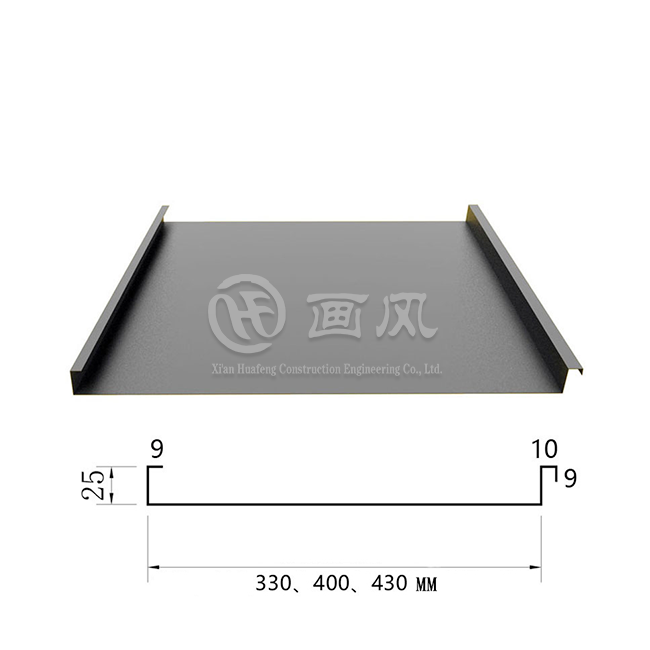
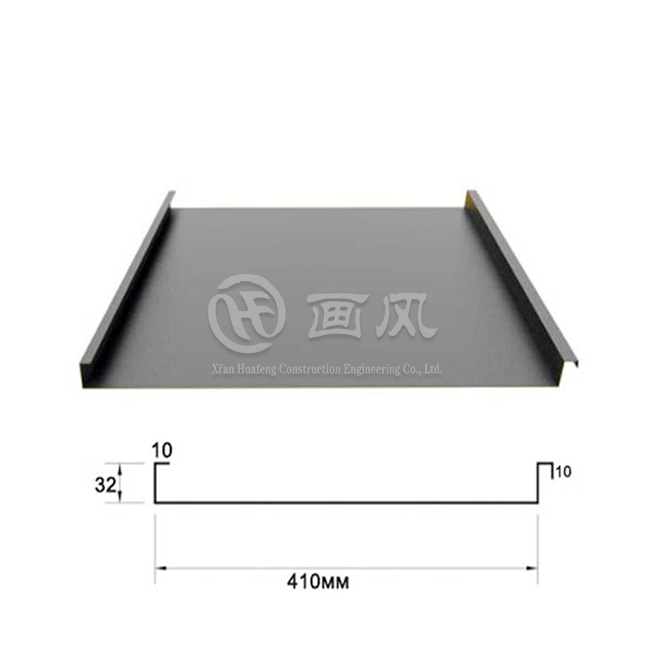
Picking a panel starts with choosing the rib height and panel width. There are two main profiles for HF's standing seam panels: 25-330/400/430 (1" rib height, 330–430mm cover width) and 32-300/410/430 (1.25" rib height, 300–430mm cover width). These panels can be used for a wide range of commercial and institutional tasks. For longer purlin spacing and areas with heavier snow loads, the 32mm rib profile is better because it can span more structures.
Material substrate and coating selection follow slope, environment, and budget. Galvalume steel, galvanized steel, aluminum, stainless steel, copper, and titanium zinc are some of the materials that can be used. It is between 0.5 mm and 1 mm thick. For uses that will be used near the coast or in harsh environments, the minimum standard is a 0.7 mm Galvalume base with a 25–40 µm PVDF topcoat. Color matching against RAL standards or custom color goals is a constant procurement pain point for contractors handling multiple phases of projects. Batch-controlled production runs help with this, ensuring mechanical lock metal roofing consistency.
Compliance documentation is the final filter. Test reports must be in line with ASTM, DIN, JIS, BS, or GB/T, based on the project authority's area. Before committing to a seller, procurement managers looking for goods for business projects in the United States should make sure they get ASTM E1592 wind uplift test results and ASTM E108 fire test certifications.
Procurement Guide: Ordering and Supply Chain Insights
What to Confirm Before Placing a Purchase Order?
When experienced procurement managers buy mechanically seamed standing seam panels from a manufacturer overseas, they have to keep a close eye on a number of factors. Four things cause the most trouble: lead time, making sure that MOQ matches project amounts, making sure that colors stay the same from batch to batch, and making sure that packaging stays intact during ocean freight.
HF can make 1,000 tons of goods every month at three factories: a plant for raw materials in Anhui Province and processing plants in Hangzhou and Xi'an. These factories have seven production lines and more than 40 machines. The normal time for delivery is 15–20 days after the order is confirmed. The smallest amount that can be ordered is 500 square meters, which is equal to 1 metric ton. This is so that single-project orders can be met without causing workers to keep extra supplies on hand. Panels come in safe packing that is designed to keep them from deforming during shipping, which is the main reason why edges get damaged on long runs of panels.
All of the goods meet the quality standards set by ISO 9001 and have certifications from ISO 14001, SGS, and CE. These certifications provide the third-party proof that procurement compliance teams need before they can work with a new seller.
Conclusion
Mechanical lock metal roofing is the best option for commercial and industrial projects that need to be waterproof, resistant to wind uplift, and have a 30-year service life. The system's floating-clip thermal management, hidden fastener design, and ASTM-compliant performance data address the specific failure modes that put building owners at risk of liability and high lifetime costs. A good long-term supply relationship is different from a one-time order deal because you need to choose the right panel profile, substrate, coating, and maker with approved quality systems and production scale.
FAQ
1. What is the difference between snap-lock and mechanical lock standing seam?
You don't need a seaming tool to connect snap-lock panels; just press the male leg into the female leg. That speeds up installation on higher slopes but makes it less resistant to wind lifting. Mechanical lock metal roofing needs to be physically crimped to make a better structural interlock that can be used in areas with a lot of wind and on low slopes.
2. Can these panels be installed over an existing roof?
Yes, this is a common way to use a sub-framing system to make an old building stronger, as long as the old building passes a load test. Metal plates are pretty light—about 1.5 pounds per square foot—so they can usually be added without adding to the structure.
3. How do I verify batch color consistency between shipments?
Ask the maker for spectrophotometer color tolerance reports (ΔE values) for every batch of production. HF's PVDF coating lines make products that meet RAL reference standards and keep detailed records of each batch. This lets you directly compare orders on projects that are being worked on in more than one step.
4. What seaming tools are compatible with HF panels?
HF panels are made to work with normal electric seaming tools that are used for industrial roofing in North America. Talk to HF's technical team about which tool models will work with each other and how to set the calibration parameters before sending your crew out.
Request a Custom Quote from HF — Mechanical Lock Metal Roofing Supplier
HF (Xi'an Huafeng Construction Engineering Co., Ltd.) has three certified factories that make a total of 1,000 tons of goods every month and ship them all over the world in 15–20 days. Our technical team is ready to help you with your next bid, whether you need test paperwork that meets ASTM standards, special RAL color matching, or project-specific panel lengths of up to 12 meters. To get details and a price for your project, email our mechanical lock metal roofing manufacturer team at huafeng@hfmetalroof.com or go to hfmetalroof.com.
References
1. Metal Construction Association (MCA). Guide to Metal Roofing: Standing Seam Systems. 2021.
2. National Roofing Contractors Association (NRCA). The NRCA Roofing Manual: Metal Panel and SPF Roof Systems. 2022.
3. ASTM International. ASTM E1592: Standard Test Method for Structural Performance of Sheet Metal Roof and Siding Systems. 2023.
4. ASTM International. ASTM E1646: Standard Test Method for Water Penetration of Exterior Metal Roof Panel Systems. 2019.
5. Sheet Metal and Air Conditioning Contractors' National Association (SMACNA). Architectural Sheet Metal Manual, 7th ed. 2012.
6. RS Means / Gordian. Building Construction Cost Data: Roofing Systems — Commercial Metal Panels. 2023.





YOU MAY LIKE
_1783936484206.webp "Inside locking metal aluminum cladding panel")
_1768552571575.jpg "Aluminium Fascias")