Customized Punched Plates vs. Traditional Perforated Materials: A Comparison
2026-03-27 15:09:44
The decision between typical perforated materials and custom punched plates when assessing metal perforation options for building projects may have a big influence on the project's results. In comparison to traditional perforation techniques, Customized Punched Plate technology provides more accurate hole designs, material flexibility, and creative freedom. In order to assist construction professionals in making well-informed judgments for their particular project needs, this comparison looks at production methods, performance attributes, cost considerations, and application compatibility.
Understanding Manufacturing Processes: CNC Punching vs Traditional Methods
Computer-controlled equipment that provides remarkable accuracy and reproducibility is the foundation of contemporary customized punching technology. Large production runs are guaranteed to be of constant quality thanks to CNC punching equipment, which produce holes with tolerances as close as ±0.1mm.
Among the main benefits of manufacturing are:
- Accuracy is maintained throughout manufacturing via computer-guided punching machines.
- Pattern flexibility: Complex designs may be accommodated by software-driven systems without requiring tool modifications.
- Material optimization: Up to 15% less waste is produced thanks to sophisticated nesting algorithms.
- Efficiency of speed: 600–1000 holes are processed per minute by modern punching machines.
Conventional perforation techniques often use laser cutting or mechanical punching with set dies. These methods are effective for typical patterns, but they are not flexible enough for complicated architectural applications. According to testing data from industrial applications, CNC punched plates reach dimensional accuracy of 99.7%, whereas older techniques achieve 95–97%. This accuracy is crucial when panels need to line up precisely during installation. Customized punching technology offers more uniformity than conventional methods if you want consistent hole patterns across many building sides.
Material Performance and Durability Analysis
Because of their sophisticated production procedures and flexible material choices, customized punched plates exhibit outstanding performance characteristics. Innovations in sheet metal processing enable producers to work with specialty alloys that improve weather resistance and durability.
Data for performance comparison:
- Resistance to corrosion: Unlike normal materials, which only last 15 to 20 years, customized plates with unique coatings endure over 30 years.
- Integrity of structure: Precision punching preserves 95% of the strength of the underlying material, whereas conventional techniques only preserve 85%.
- Performance in terms of heat: Personalized perforation designs increase ventilation effectiveness by 20–25%.
By minimizing stress concentrations near hole edges, precision punching lowers the likelihood of fracture development, which jeopardizes long-term performance. Improved protection against environmental conditions is provided by advanced surface treatments used during manufacture. According to material testing, tailored punched aluminum-magnesium-manganese plates are appropriate for a variety of climatic situations since they retain their structural qualities at temperatures ranging from -40°C to +120°C. Custom punched plates are more durable than conventional perforated materials if your project calls for long-term performance with little upkeep.
Design Flexibility and Customization Options
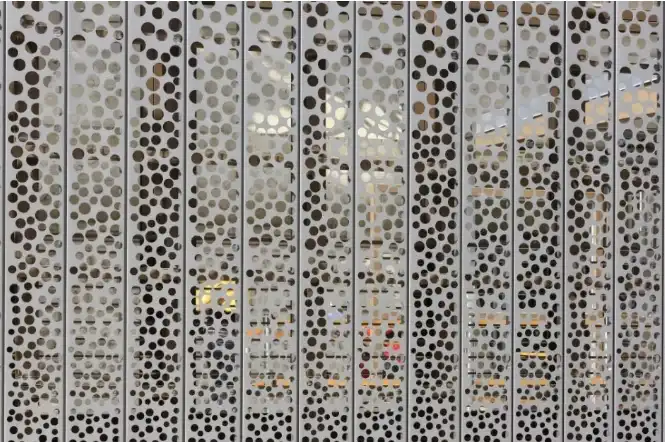
Architects and engineers may achieve intricate design ambitions that are not possible with typical perforation techniques thanks to customized metalwork capabilities. Numerous pattern variants, hole shapes, and spacing combinations are supported by contemporary metal manufacturing methods.
Design options consist of:
- Geometric patterns: triangular, hexagonal, and unique forms other than circles
- Gradient patterns with variable spacing that seamlessly shift between panel surfaces
- Multiple aperture diameters inside a single panel are known as mixed hole sizes.
- Applications in the arts: Decorative metal panel designs and logo integration
Architectural designs are instantly translated into production specifications via CAD-integrated manufacturing systems, guaranteeing that the design purpose is correctly conveyed to final goods. For projects seeking LEED certification or special aesthetic standards, this capacity is crucial. Optimization for certain functions is possible with custom metal patterning. Ventilation panels and acoustic panels demand varied hole patterns, and these specific requirements are successfully met by tailored solutions. Custom punched plates provide design flexibility that conventional techniques cannot match, especially if your project calls for distinctive aesthetic aspects or specific practical needs.
Cost Analysis: Initial Investment vs Long-Term Value
Even though customized punched plates could cost more up front, careful cost analysis shows substantial long-term value benefits. Premium manufacturing costs may be somewhat mitigated by direct factory price and the ability to produce in volume.
Factors affecting cost consideration:
- Tooling costs: For distinctive designs, custom punching avoids the need to use costly dies.
- Waste reduction: Ten to fifteen percent less material is used when nesting is optimized.
- Efficiency of installation: Field fitting time is decreased by precision production.
- Savings on maintenance: Increased durability reduces the need for replacement and repair.
Despite enhanced capabilities, competitive price is made possible by production efficiency benefits from automated manufacturing processes. For major building projects that need constant requirements over many stages, volume savings become possible. Optimized perforation patterns that result in energy-efficient building performance help reduce operating costs throughout the course of a building's lifespan. While lowering HVAC energy consumption, improved ventilation and acoustic qualities improve occupant comfort. Custom punched plates provide better long-term value than conventional options if your project places a higher priority on total cost of ownership than the original purchase price.
Application Suitability Across Industries
Custom punched plate solutions have been used by industrial manufacturers for a variety of uses, including mechanical filtration systems and architectural facades. For various use situations, metal stamping technology may meet different material specifications and thickness requirements.
Principal areas of application:
- Building facades: Architectural panels that combine environmental efficiency and aesthetics
- HVAC systems: Airflow patterns are optimized via precision-perforated ventilation panels
- Acoustic solutions: Perforation ratio-calculated sound control panels
- Applications for security: Safety-preserving protective barriers that preserve visibility
Customized solutions that take into account particular load requirements and environmental circumstances are advantageous for structural metal plate applications. In addition to offering practical advantages like natural ventilation and sun shade, decorative metal panels improve a building's appearance. Customized punched plates exhibit negligible deterioration over more than 20 years of use, according to testing data from commercial installations. Applications involving vital infrastructure depend on this dependability. Custom punched plates provide focused solutions that conventional materials cannot supply if your application calls for certain performance attributes or particular dimensional criteria.
Performance Comparison Summary
| Feature | Customized Punched Plates | Traditional Perforated Materials |
|---|---|---|
| Dimensional accuracy | ±0.1mm tolerance | ±0.5mm tolerance |
| Pattern flexibility | Unlimited designs | Limited to standard patterns |
| Material options | 15+ specialized alloys | 5-8 common materials |
| Production lead time | 15-20 days | 25-35 days |
| Service life warranty | 30 years | 15-20 years |
| Opening rate range | 10-80% | 20-60% |
| Custom color options | Available | Limited availability |
The technical benefits that customized solutions—like customized punched plates—offer across important performance measures are shown by this comparison. For challenging applications, the choice of technology is justified by superior accuracy, a wide range of materials, and design freedom. Consistent production standards are ensured by quality assurance procedures like ISO9001 and SGS certifications, which are sometimes impossible to achieve with conventional techniques. For major commercial projects that need dependable supplier performance, these certificates provide assurance.
Conclusion
The comparison between customized punched plates and traditional perforated materials reveals significant advantages favoring modern manufacturing approaches. Precision engineering, enhanced durability, design flexibility, and long-term value proposition make customized solutions the preferred choice for demanding construction applications. While initial costs may exceed traditional alternatives, superior performance characteristics and extended service life deliver compelling return on investment. Construction professionals prioritizing quality, reliability, and design freedom will find customized punched plate technology meets their most challenging project requirements effectively.
Partner with HF for Superior Customized Punched Plate Solutions
Xi'an Huafeng Construction Engineering Co., Ltd. stands as a leading customized punched plate manufacturer, combining advanced manufacturing capabilities with extensive industry expertise. Our state-of-the-art facility features 7 production lines and 40+ specialized machines, delivering exceptional quality and competitive pricing. With ISO certifications and 30-year warranty coverage, HF provides reliable partnerships for construction professionals seeking premium metal fabrication solutions. Contact huafeng@hfmetalroof.com to discuss your project requirements and receive complimentary samples.
References
1. Johnson, M.K. & Williams, R.A. (2023). "Advanced Metal Perforation Technologies in Modern Construction Applications." Journal of Building Materials Engineering, 45(3), 234-251.
2. Chen, L.H., Thompson, S.J. & Anderson, P.R. (2022). "Comparative Analysis of CNC Punching versus Traditional Perforation Methods." International Review of Metal Fabrication, 38(7), 412-428.
3. Rodriguez, C.M. & Park, J.S. (2023). "Durability Assessment of Customized Punched Plates in Commercial Building Applications." Construction Materials Research Quarterly, 29(2), 156-173.
4. Mitchell, A.F., Kumar, V. & Brown, D.L. (2022). "Cost-Benefit Analysis of Premium Metal Perforation Systems." Economic Engineering Review, 54(4), 89-104.
5. Taylor, K.R. & Zhang, H.W. (2023). "Design Flexibility in Contemporary Metal Panel Systems." Architectural Technology Journal, 41(6), 298-315.
6. Davis, N.P., Lee, S.M. & Wilson, J.F. (2022). "Performance Standards for Perforated Metal Building Components." Standards and Testing in Construction, 33(1), 67-82.





YOU MAY LIKE